
The words can feel like a wall: coding agent, repository, deploy, database, runtime. All at once, before you've built anything. So I use a kitchen as a framing device. Every piece of the stack becomes a station in a kitchen you already understand. De woorden kunnen voelen als een muur: coding agent, repository, deploy, database, runtime. Allemaal tegelijk, voordat je ook maar iets gebouwd hebt. Daarom gebruik ik een keuken als beeld. Elk onderdeel van de stack wordt een station in een keuken die je al kent.
Why a metaphor? Waarom een metafoor?
Picture opening a restaurant. You already know there's a kitchen, a pantry, a recipe book, and a building to welcome guests into. You don't need to know how the oven works to understand why it's there. Shift that mental model across to building an app and, suddenly, nothing about the stack is unfamiliar. Stel je voor dat je een restaurant opent. Dan weet je al dat er een keuken is, een voorraadkast, een receptenboek en een pand waar gasten binnenlopen. Je hoeft niet te weten hoe het fornuis werkt om te snappen waarom het er staat. Pas dat beeld toe op een app bouwen en opeens is er niets aan de stack meer vreemd.
The five stations De vijf stations

The station. The chef is the one who actually cooks. You describe what should be on the menu, and the chef makes it happen. Het station. De chef is degene die daadwerkelijk kookt. Jij beschrijft wat er op het menu moet, de chef maakt het.
In real terms. A coding agent is an AI that writes, edits and runs your code. You talk, it builds. In de praktijk. Een coding agent is een AI die je code schrijft, aanpast en uitvoert. Jij praat, hij bouwt.
My choice. Claude Code, from Anthropic. It runs in the Claude Desktop app, has a generous memory for long conversations, and keeps the workflow calm and readable. Mijn keuze. Claude Code van Anthropic. Draait in de Claude Desktop-app, heeft een royaal geheugen voor lange gesprekken en houdt de werkstroom rustig en overzichtelijk.
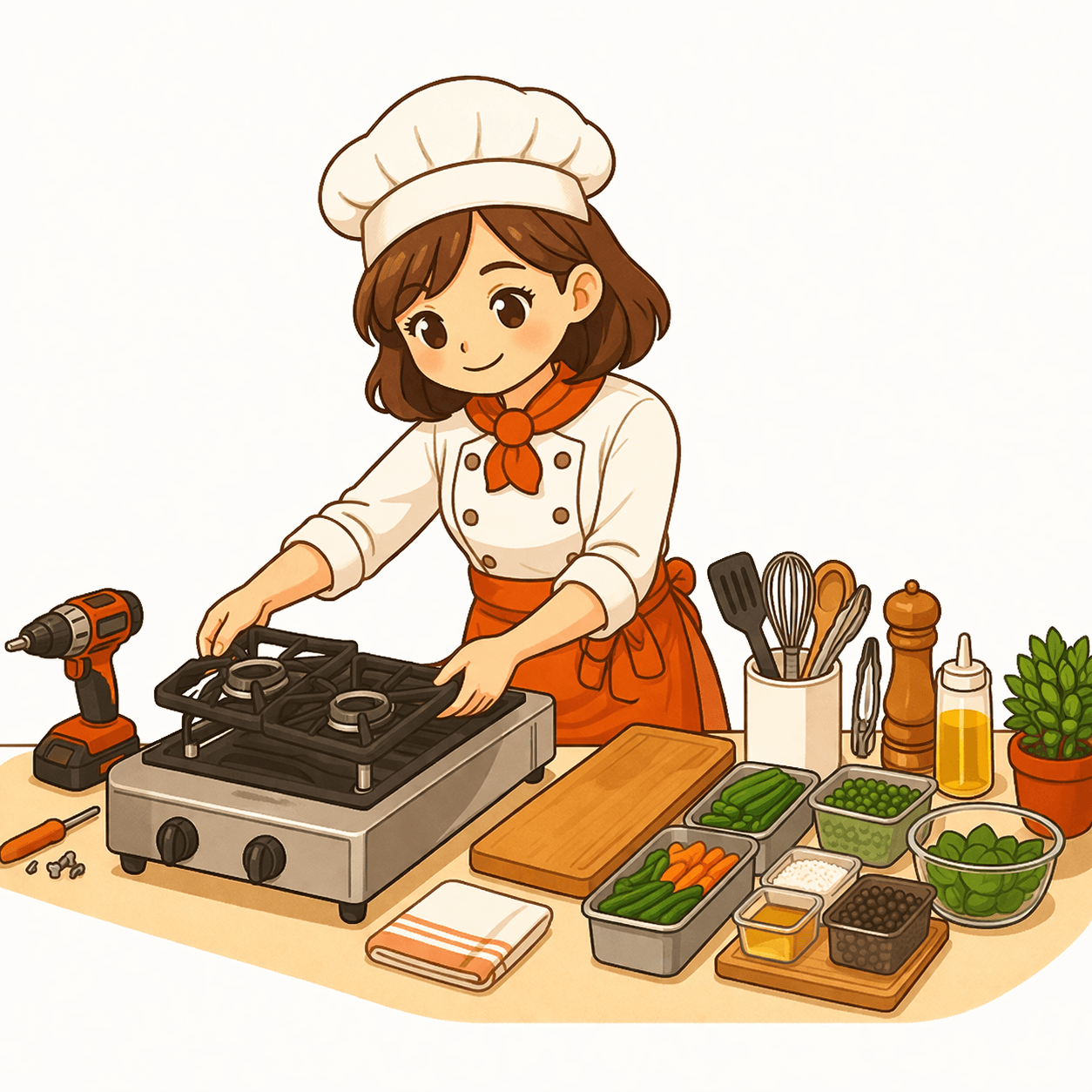
The station. Before any cooking happens, the kitchen has to work. Node.js is the gas burner, it's what brings the heat. Git is the mise en place, every step laid out and every version tracked. Het station. Voordat er gekookt wordt, moet de keuken werken. Node.js is het gasfornuis, dat levert de warmte. Git is de mise en place, elke stap overzichtelijk klaargezet en elke versie bijgehouden.
In real terms. Node.js lets your computer run JavaScript code. Git quietly tracks every change you make so you can always go back. In de praktijk. Node.js zorgt dat je computer JavaScript-code kan uitvoeren. Git houdt stil op de achtergrond elke wijziging bij die je maakt, zodat je altijd terug kunt.
My choice. Both the standard. You install them once and forget about them. There's no meaningful reason to swap them out as a beginner. Mijn keuze. Allebei de standaard. Je installeert ze één keer en vergeet ze. Er is geen zinvolle reden om hier als beginner van af te wijken.

The station. Every recipe, every edit, every past version, safely archived in the cloud. Het station. Elk recept, elke aanpassing, elke oudere versie, veilig opgeslagen in de cloud.
In real terms. GitHub stores your project online, keeps its full history, and makes it easy for your chef and your hosting platform to work together. In de praktijk. GitHub bewaart je project online, houdt de complete geschiedenis bij en laat je chef en je hostingplatform soepel samenwerken.
My choice. GitHub, because almost the entire ecosystem is built around it and Claude Code integrates seamlessly. Mijn keuze. GitHub, omdat zo goed als het hele ecosysteem eromheen is gebouwd en Claude Code er naadloos op aansluit.

The station. The building itself. Where guests walk in and actually taste what the chef made. Het station. Het pand zelf. Waar gasten binnenlopen en proeven wat de chef heeft gemaakt.
In real terms. Vercel is hosting. It takes your code from GitHub and puts it on a real URL on the internet, automatically, every time you save. In de praktijk. Vercel is hosting. Het pakt je code van GitHub en zet die op een echte URL op het internet, automatisch, elke keer dat je opslaat.
My choice. Vercel, for its generous free tier, its one-click deploys from GitHub, and because it's built for the framework we use (Next.js). Mijn keuze. Vercel vanwege de royale gratis tier, deploys met één klik vanuit GitHub, en omdat het is gebouwd voor het framework dat we gebruiken (Next.js).

The station. Where the ingredients are kept. Cold room, shelves, jars. If it's not here, you can't cook with it. Het station. Waar de ingrediënten liggen. Koelruimte, schappen, potten. Wat hier niet is, kun je ook niet koken.
In real terms. Supabase is a database. It stores all the things your app needs to remember: users, posts, lists, whatever your app is built to hold. In de praktijk. Supabase is een database. Hier zit alles wat je app moet onthouden: gebruikers, berichten, lijstjes, wat je app ook maar bewaart.
My choice. Supabase, because it combines the database, a login system and a friendly web interface in one, with a free tier that goes a long way. Mijn keuze. Supabase, omdat het database, inlogsysteem en een prettige webinterface in één combineert, met een gratis tier waar je lang mee vooruit kunt.
Personal choices, not the only choices Persoonlijke keuzes, geen enige keuzes
These five are choices that work for me and for beginners. Every station has alternatives, and the metaphor itself doesn't change. Every app, whichever tools you pick, has a chef, a kitchen, a recipe book, a pantry and premises. Deze vijf zijn keuzes die bij mij en bij beginners goed werken. Voor elk station zijn er alternatieven, en de metafoor zelf verandert er niet van. Elke app, met welke tools je ook kiest, heeft een chef, een keuken, een receptenboek, een voorraadkast en een pand.
Building your own kitchen or renting one Een eigen keuken bouwen of er eentje huren
There's another route you can take. You can skip the separate stations entirely and work inside a single all-in-one platform. Tools like Replit, Base44 and Lovable combine chef, pantry, recipe book and premises into one product. You sign up, describe your app, and it all happens in one place. Er is nog een andere route die je kunt nemen. Je kunt de aparte stations overslaan en in één allesomvattend platform werken. Tools als Replit, Base44 en Lovable combineren chef, voorraad, receptenboek en pand in één product. Je meldt je aan, beschrijft je app, en alles gebeurt op dezelfde plek.
Neither approach is better than the other, they answer different questions. Geen van beide aanpakken is beter dan de andere, ze beantwoorden een andere vraag.
| Complete stack (what we use)Complete stack (wat wij gebruiken) | All-in-one platformAll-in-one platform | |
|---|---|---|
| What it isWat het is | Separate tools per job, wired togetherAparte tools per taak, aan elkaar gekoppeld | One platform that does everythingEén platform dat alles doet |
| SetupOpzetten | Takes some preparation, then you have your own kitchenKost wat voorbereiding, daarna heb je je eigen keuken | Ready to go in five minutesBinnen vijf minuten aan de slag |
| ControlControle | You own every piece and can swap parts outJij bent eigenaar van elk stukje en kunt onderdelen vervangen | You're bound to the platform's choicesJe zit vast aan de keuzes van het platform |
| Learning curveLeercurve | Steeper at the start, much easier from the second project onwardAan het begin steiler, vanaf het tweede project veel soepeler | Gentler, but you learn the platform rather than the fundamentalsZachter, maar je leert het platform in plaats van de basis |
| PortabilityOverdraagbaarheid | High, your code runs anywhereHoog, je code draait overal | Low, leaving is usually hardLaag, vertrekken is vaak lastig |
| Cost at scaleKosten bij groei | Each piece has its own free tier, you only pay for what growsElk onderdeel heeft een eigen gratis tier, je betaalt alleen wat meegroeit | Predictable subscription, can add up with more usageVoorspelbaar abonnement, kan oplopen bij meer gebruik |
| Best forGeschikt voor | Anyone who wants to keep building and understand what's happeningWie blijft bouwen en wil begrijpen wat er gebeurt | Quick prototypes or one-off appsSnelle prototypes of losse apps |
In the masterclass we deliberately choose the complete stack. Not because it's better, but because it lets you meet each station separately. After one time you know what each part does, and you can decide for yourself which approach fits your next project. In de masterclass kiezen we bewust voor de complete stack. Niet omdat die beter is, maar omdat je de stations daarin apart leert kennen. Na één keer weet je wat elk onderdeel doet, en kun je daarna zelf beslissen welke aanpak bij je volgende project past.
Curious about the practical side? The participant pages hold the full preparation and workshop instructions. Or follow along for updates and future masterclasses. Benieuwd naar de praktische kant? Op de deelnemerspagina's staan de volledige voorbereidings- en workshop-instructies. Of volg mee voor updates en nieuwe masterclasses.